
Does Alopecia Areata weaken the immune system?
Our latest study in Clinical and Experimental Dermatology looked at the population-level data to find an answer.
The Clinical Gap: Alopecia Areata (AA) is a non-scarring, systemic hair loss disease that deeply affects a patient's well-being, but it was previously unknown if people with AA face an increased risk of common infections.
The Outcome: Using real-world primary care data from the Oxford-Royal College of General Practitioners Research and Surveillance Centre (RCGP RSC), the study found a slightly higher incidence of infections in people with AA. Crucially, this isn't necessarily a sign of a weaker immune system; rather, it is often a sign of better healthcare engagement.
The Impact: By clarifying the complex relationship between autoimmunity and immune function in AA, this research directly informs disease management and clinical decision-making. It has become highly cited across research communities and is even cited in medical textbooks.
We've summarised the key takeaway message below.
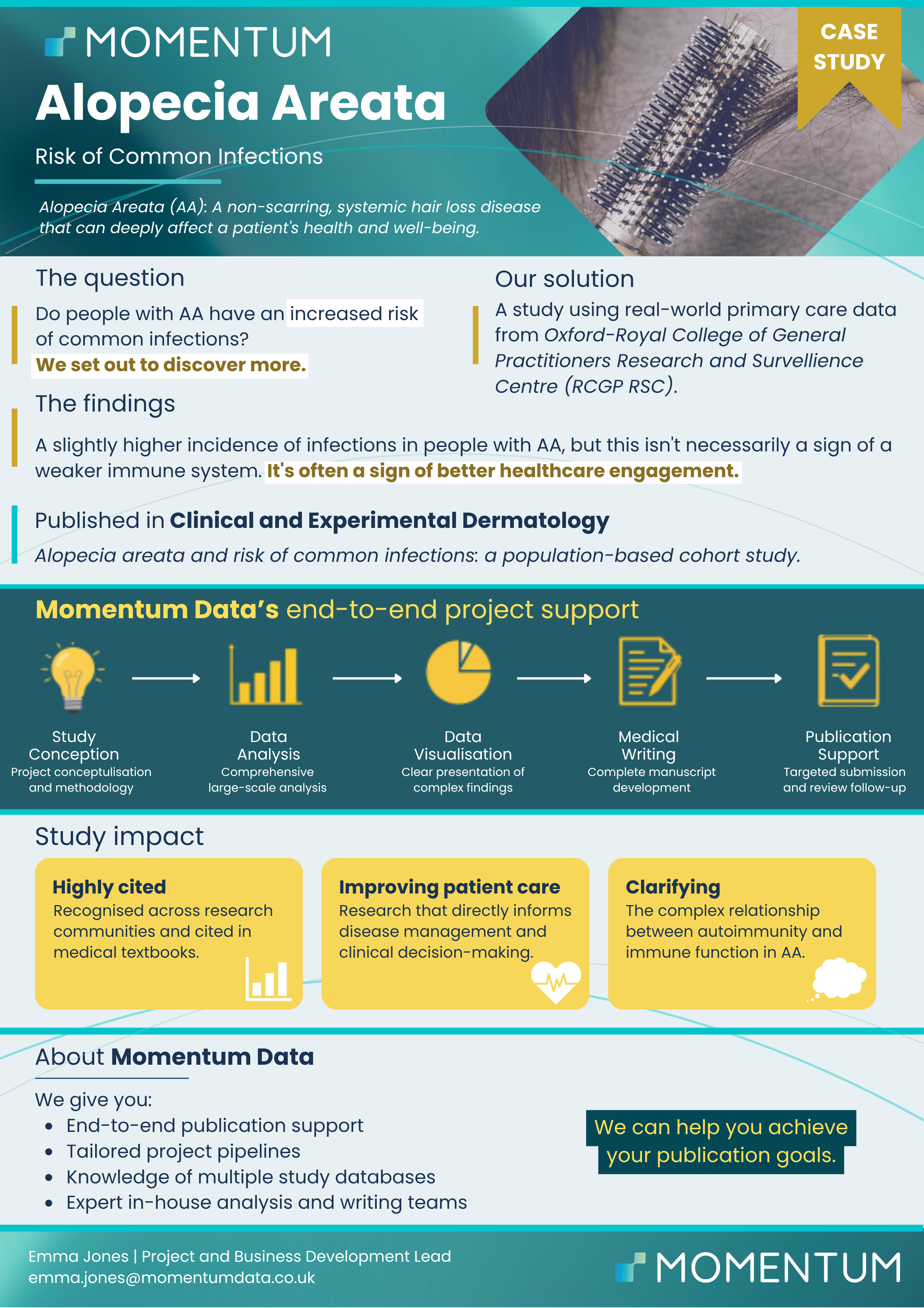
To bring this study to life and uncover the true infection risks associated with alopecia areata, Momentum Data provided end-to-end project support.
Our core contributions included:
Study Conception: Project conceptualisation and methodology.
Data Analysis: Comprehensive large-scale analysis.
Data Visualisation: Clear presentation of complex findings.
Medical Writing: Complete manuscript development.
Publication Support: Targeted submission and review follow-up.
Turning real world data into impactful evidence
Ultimately, our goal is simple:
To produce dynamic, engaging outputs that truly tell the story of the evidence - and make sure it’s heard.